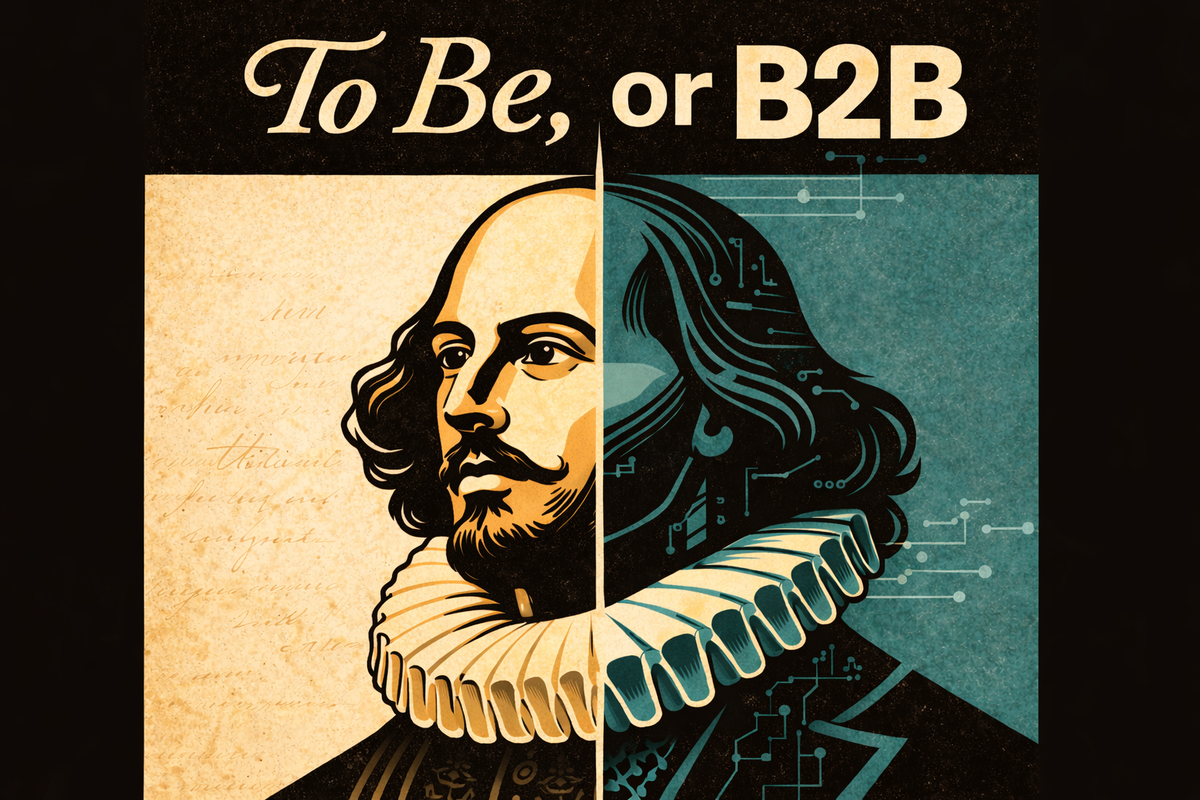
Why B2B tech companies must prioritise storytelling over sales for business success.
In today’s B2B technology landscape, many companies still prioritise transactional sales over the compelling potential of storytelling. Just as Hamlet’s famous soliloquy reflects an existential dilemma, B2B tech companies face their own choice: should they focus on short-term sales gains or invest in building emotional connections through storytelling? I believe that companies which prioritise storytelling - especially human-centred narratives - will see far greater long-term commercial success. This is because B2B organisations, like their consumer counterparts, are brands with a story to tell, and B2B customers are susceptible to those stories for the following reasons.
The Evolutionary Power of Storytelling
Storytelling is deeply rooted in human evolution. Yuval Noah Harari, in his seminal work Sapiens, makes the case that our ability to create and believe in collective stories - such as religion, money, corporations, and nations - is what has set humans apart from every other species. These abstract stories only have value because large groups of people agree that they do. Such stories have allowed humans to organise in large numbers, cooperate, and thrive as a species. Without them, modern society as we know it wouldn’t exist.
For B2B brands, this means that storytelling has the power to unify and engage large groups of people, whether they be customers, partners, or stakeholders. It’s not enough to focus on products or services alone; people need to believe in the vision, mission, and purpose behind what a company does. Technology, which often feels abstract, becomes more real and meaningful when its story is tied to human experiences. This is because the evolutionary process has resulted in biological and psychological factors which make storytelling essential to all humans.
Biological and Psychological Links to Storytelling
On a biological level, storytelling activates multiple areas of the brain through a process called neural coupling, which creates connections between the narrative and the listener’s own sensory and emotional experiences. This explains why we’re more likely to remember stories than raw data or product specifications. Stories trigger dopamine release, enhancing memory and engagement, while increasing oxytocin levels, known as the bonding hormone, which fosters empathy and trust. Storytelling can also influence cortisol levels, reducing stress and creating a calmer state of mind. These neurochemical responses promote emotional engagement, essential for building lasting relationships with customers.
Psychologically, our brains are wired to seek patterns and structure, making storytelling a natural way to understand and retain information. Stories are easier for us to comprehend than isolated facts because they follow a familiar structure: beginning, middle, and end. Therefore, for B2B companies, weaving a compelling narrative around the human impact of their technology can help prospects and customers better grasp the complexity and value of their offerings.
In his 2007 book, Story Proof: The Startling Power of Story, Kendall Haven concludes that “research overwhelmingly, convincingly, and without opposition provides the evidence” that stories are a highly efficient “vehicle for communicating factual, conceptual, emotional, and tacit information.”
The Business Case for B2B Storytelling
While evidence supports the power of storytelling, B2B communicators may encounter hesitation from senior executives who are primarily focused on immediate sales outcomes. These leaders sometimes view storytelling as less critical, favouring metrics like ROI, efficiency gains, and cost reduction. As detailed however, overlooking the value of storytelling is to overlook fundamental aspects of human evolution, biology, and psychology.
Historically, B2B communications have been geared towards rational appeals - outcomes such as increased profitability or operational efficiency - while emotional engagement was reserved for consumer communications. But the landscape has shifted. The "consumerisation" of B2B marketing means focusing not just on business metrics but on the human stories behind technology. Today, it’s clear that B2B decision makers, like consumers, are influenced by personal motivations and emotional connections.
A study from Google and CEB revealed that B2B customers are significantly more emotionally connected to their vendors and service providers than consumers. Storytelling can increase conversion rates by as much as 30%, because it makes abstract or complex offerings more relatable, tangible, and relevant to the buyer’s experience. 84% of B2B buyers base their decisions on emotions according to a Forrester survey. And the cognitive psychologist Jerome Bruner postulated that we are twenty-two times more likely to remember facts that are contained within stories. The outdated belief that B2B decisions are driven purely by logic no longer holds true.
Ironically therefore, companies that embrace storytelling achieve exactly what the doubters desire - repeat sales. Storytelling builds long-lasting brand equity, differentiating companies in crowded markets, strengthening emotional connections, and driving long-term competitive advantage.
Why Storytelling is Critical for B2B Targeting SMBs and Mid-Sized Corporates
Storytelling’s impact is particularly important for B2B tech companies targeting Small Medium Businesses (SMBs) and mid-sized corporations. These businesses often lack procurement departments or sophisticated IT teams to guide their technology purchases. As a result, they are more likely to make decisions based on the stories they hear - stories about how a product or service has helped other businesses like theirs, aspirational stories that show how technology has improved lives in a meaningful way.
The loyalty generated through storytelling is invaluable in these sectors. SMBs and mid-sized corporations are more likely to stay with a brand that makes them feel understood and supported, rather than just sold to. By focusing on the human benefits of technology, rather than just its features, B2B brands can create lasting relationships and grow their market share.
The Limitations of Traditional B2B Communications
Traditional B2B marketing and communications tactics - such as industry events, analyst report logos, or supplier technical certificates - are valuable and necessary, but are not substitutes for genuine storytelling. They lack the emotional or human element required to foster true engagement. They don't tell a compelling story about the people behind the technology you provide or the customers whose lives have been positively impacted. Storytelling goes much deeper.
For example, in my corporate and B2B role at eBay, I focused on highlighting the platform’s economic impact and transformative power for sellers. While eBay seller tools like customer insights and sales tracking were important, what truly inspired me were the remarkable success stories of the sellers. Like the Lithuanian entrepreneur who sold his first pair of trainers on eBay as a teenager before establishing a global sportswear business, serving 97 countries. The German couple who revived their failing family business through eBay. Or the British man who turned his mother’s homemade Indian spices into a global export business, serving customers across three continents. I was also deeply moved by the efforts of my Italian colleagues, who led a campaign to support businesses in L’Aquila, helping them overcome adversity as they rebuilt after the devastating earthquake in the region.
This is storytelling.
Practical Steps for Embedding Storytelling in B2B Companies
Make storytelling a company-wide culture. Storytelling shouldn’t be confined to the marketing team - it must permeate the entire organisation. Everyone plays a part in sharing and contributing stories that reflect the company’s values.
Align stories with your brand’s mission. Every story you tell should tie back to your company’s mission and core values. Stories must demonstrate your purpose, showing how your technology makes a tangible impact on real lives.
Lead by example: secure leadership buy-in. For storytelling to be truly effective, senior leadership must be on board. When leaders actively champion storytelling, it gains credibility across departments, encouraging everyone to align their communications with the broader narrative.
Humanise your brand. Move away from being a faceless corporation and show the human side of your business. Authentic, personal stories about the people behind your technology or your customers’ successes foster genuine connections.
Be a story detective. Uncover the hidden stories within your company. Great PR and communications professionals are like detectives, searching for compelling narratives that aren’t always immediately obvious. Great human interest stories are always there to be found.
Go beyond case studies. Case studies are valuable, but they shouldn’t just highlight business metrics. Ensure they also include human stories, highlighting personal journeys, motivations, and moments of adversity.
Conclusion: To Be, or B2B?
In today’s competitive landscape, the choice between focusing on sales or storytelling isn’t just a tactical decision, it’s an existential one. B2B tech companies that embrace the power of storytelling will build stronger brands, foster deeper customer loyalty, and achieve greater long-term success.
The answer to "To be, or B2B?" lies in the stories we choose to tell - and the human connections we create along the way.