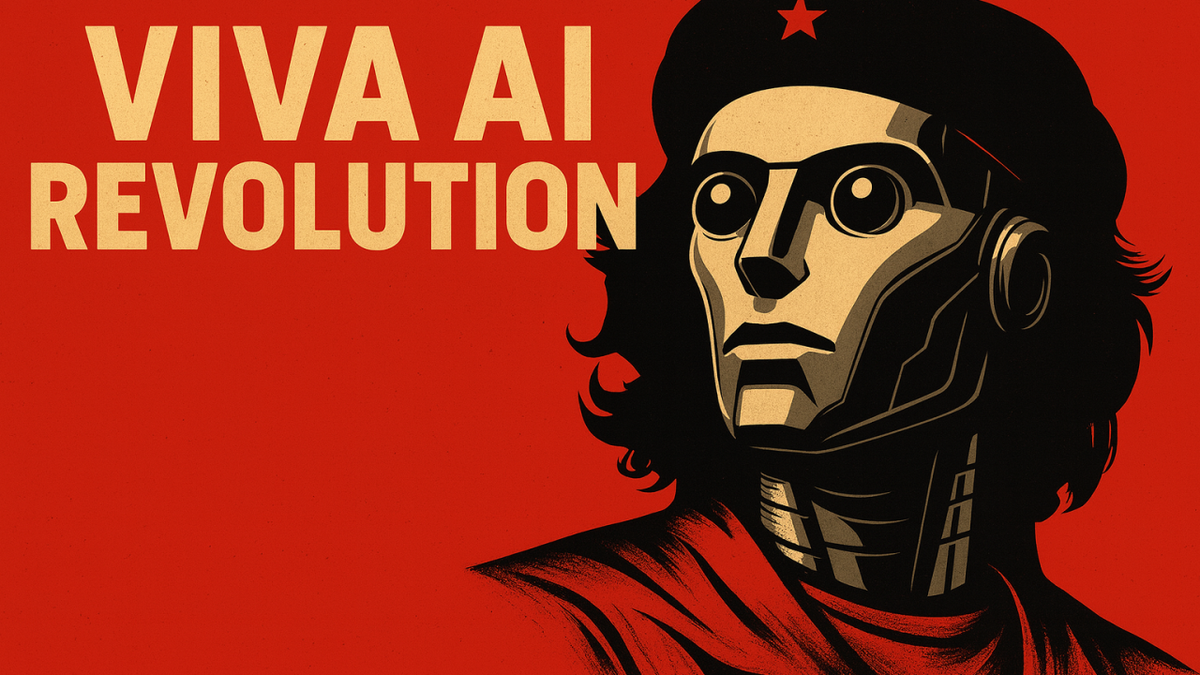
History shows us that every great technological leap follows the same pattern. AI is no different, only faster.
Mark Twain once said, “History doesn’t repeat itself, but it often rhymes.” That line has always struck me as one of the best observations of human and technological progress.
Technological shifts that change the world tend to show the same characteristics and stages; stages that can be observed and relied upon to occur again. While the technology and the companies leading the change may differ, the trends and cycles behind them do not. The reason for this is partly due to structural necessity but more so because of human psychology, which never changes.
We are now witnessing the dawn of arguably the greatest technological force in human history, artificial intelligence. We do not yet know what its impact on humanity will be, but history gives us an excellent guide to its likely stages. So while AI itself is new, the patterns behind it are not. These patterns can be seen in past technological revolutions. In fact, I witnessed a similar story unfold when the internet began to emerge in the 1990s before taking off in the 2000s. The same phases are happening again now, only much faster.
I began my PR and communications career at Carphone Warehouse, Europe's largest mobile phone retailer, just as the internet was becoming part of everyday life, and before smartphones brought it to our hands. I was fortunate to work on some of the most important mobile phone launches of the 2000s. The internet revolution that took place then offers a clear roadmap for how world-changing technologies, including AI, will evolve. They start relatively quietly with the structural foundations, accelerate quickly before capturing the public imagination, and then everything changes.
These technological evolutions tend to unfold in three stages: infrastructure, use cases and broader transformation.
The AI revolution is already underway and we are currently at the beginning of the second stage.
Infrastructure
In the late 1990s, few people outside academia or business truly understood the internet’s potential. The Daily Mail dismissed it as a passing fad and, in 1999, David Bowie predicted the 'exhilarating and terrifying' forthcoming impact of the internet on society to a visibly bewildered Jeremy Paxman on BBC Newsnight.
While the public remained indifferent or sceptical, the real transformation was already happening behind the scenes. Companies such as Cisco were building the routers, servers and fibre that became the backbone of the internet. Cisco became one of the early winners of the internet revolution, with its stock rising more than 75,000 percent at the height of the dot-com boom, as it became the backbone of the internet.
Today, Nvidia provides the computational backbone of the AI era. Its GPUs, although originally designed for other purposes, now power the training of large language models, making Nvidia as central to AI’s development as Cisco was to the internet’s. Nvidia’s stock has grown 900 percent since 2023, demonstrating how central its chips are to the AI ecosystem.
Other infrastructure players in AI at the moment include CoreWeave, which builds cloud infrastructure that is purpose-built for AI. American Superconductor builds power-grid technology that helps move renewable energy from where it’s generated to data centres. Companies such as IREN, Hut 8, Cipher Mining and RIOT, which began as cryptocurrency mining firms, have pivoted to provide critical AI infrastructure. Many of them have seen their share prices surge in the last few months as investors bet on these companies growing massively on the back of rising AI demand.
This AI gold rush has created a new wave of ‘pick and shovel’ companies. Companies such as Micron Technology, Rambus and Seagate are providing the memory, connectivity and storage needed to make it all possible.
This phase may be relatively invisible to the general public, unless they are investors, but it is foundational and highly lucrative for the companies building the infrastructure. Every technological revolution therefore begins with invisible plumbing.
Use Cases
This is the point when a technology moves from being foundational to becoming part of everyday life.
With the internet, that moment came when portals such as Yahoo and AOL made it accessible to the public. Suddenly, the internet was no longer an abstract idea but something you could use, and the companies that enabled that shift became household names. It’s important to note that being first at this stage does not guarantee success. In the 1990s, Yahoo and AOL seemed unstoppable and investors poured money into them believing they would always be leaders. Few could have predicted that a smaller rival called Google would go on to completely redefine the web and leave them behind.
I saw a similar pattern in the mobile phone industry. When I joined Carphone Warehouse in 2002, Nokia had 35+ percent global market share. They were untouchable, or so many of us thought. That changed overnight with the launch of the iPhone in 2007. I still remember holding the iPhone for the first time. It may only have been 2G in a 3G world, and without an app store, but the screen was incredibly interactive and it enabled anyone to access the internet in a way that nobody else had thought of. Not everyone was convinced however. Steve Ballmer, the then CEO of Microsoft, ridiculed the iPhone as ‘the most expensive phone in the world’ and not a good email device. We all know how that ended.
We can clearly see that AI is following a similar path. ChatGPT made the technology accessible to anyone, but whether its launch represents an iPhone moment remains to be seen. ChatGPT may become the next Apple or the next AOL. We simply don’t know yet, but remember, first mover does not guarantee success.
What we do know is that AI applications are now multiplying at incredible speed. Tempus AI is transforming cancer care. Palantir is embedding AI into large enterprise workflows, from the NHS to the US military. Tesla is using AI to develop humanoid robots designed to perform complex real-world tasks.
This is the stage where the public’s imagination is captured. It’s where new markets, new companies and new technological habits emerge, for better and for worse.
Broader Transformation
The final stage of any technological revolution is when it stops being something we consciously use and becomes something we all depend upon. That is when entire industries change forever, which is exactly what the internet did.
Amazon began by selling books but ended up reinventing logistics and cloud computing. Google started with search but became the backbone of digital advertising. Facebook redefined how billions of people connect and communicate. PayPal made it easier to pay on eBay and went on to transform digital payments. Spotify, Uber, Airbnb, Netflix and Tinder all changed how we travel, consume entertainment and socialise.
AI has not reached this point yet, but it’s coming. Soon AI will no longer be a standalone product we interact with; it will be woven into everything we do. Every app, service and device will have some form of AI built into it, whether we notice it or not. People will stop asking, “How can we use AI?” and start asking, “How did we get by previously without it?” I can't tell you how many times I’ve heard young people ask with genuine bemusement, “How did people find things out before Google?”
This is also when paradigms shift. Just as the internet reshaped politics, economics and culture, the AI revolution will transform every aspect of society. It will challenge how we govern, work, learn and even think. It will also raise profound questions about ethics, truth, social cohesion and trust.
What This Means for Communicators
We are still early, perhaps in the equivalent of the late 1990s for the internet. The infrastructure is being built, the public is both excited and nervous about where we are heading, and the first generation of use cases is taking hold.
At the same time, AI is reshaping global power dynamics. From the race for technological supremacy between the United States and China to the growing role of AI in cybersecurity and warfare, the stakes could not be higher. The United Kingdom should, in theory, be well placed to gain a foothold given its AI heritage and the fact it isn’t constrained by the EU’s AI Act, but not if successive governments continue to undermine encryption through short-sighted and self-defeating policies.
For communicators, this is the moment that matters most. The companies that succeed in the AI era will not only be defined by the technology they develop but by the trust and human stories they tell. Every technological revolution eventually runs into a trust problem. The internet is still grappling with scams, privacy and disinformation. AI faces even higher expectations around ethics, transparency, safety and governance.
The companies that lead through authentic storytelling, particularly human-centred narratives, will build deeper trust and achieve greater long-term success. Technology may evolve, but I believe the human desire for authentic connection never changes. For example, when Garry Kasparov lost to IBM’s Deep Blue supercomputer in 1997, many observers thought interest in chess was finished, but participation and interest in the game have actually grown since then, driven by online platforms, streaming and continued public fascination. After all, nobody wants to watch two machines play chess against each other. People want stories about human creativity, resilience, and imagination. The same will be true for AI.
As Twain observed, history may not repeat, but it certainly rhymes, and those who recognise the patterns early are the ones who shape what comes next.